

Why choose an HVAC apprenticeship
You might be stuck in a job that offers no upward mobility, or perhaps you are carrying student debt for a degree that hasn’t guaranteed a paycheck. An HVAC apprenticeship offers a direct fix to these common career symptoms. Instead of paying for education that sits in a drawer, you earn a wage while you learn. This model eliminates the financial burden of tuition and provides immediate income, allowing you to build a career without starting in the red.
The demand for skilled tradespeople is not a temporary spike; it is a structural necessity. Residential and commercial buildings require constant maintenance of heating, cooling, and refrigeration systems. According to the U.S. Department of Labor, HVAC mechanics and installers are classified under occupation code 49-9021.00, reflecting the critical nature of this work in modern infrastructure apprenticeship.gov. This steady demand ensures job security that many white-collar roles cannot match.
Financially, the path is clear. While entry-level wages vary by region, the median annual wage for HVAC mechanics and installers typically falls between $50,000 and $55,000. Licensed journeymen and those in high-demand areas often exceed this range significantly.
By choosing an apprenticeship, you are trading abstract academic costs for concrete skills and real-world experience. You gain a trade that is recession-resistant, physically engaging, and financially rewarding from day one.
What the training involves
Many people enter the trade unsure if they have the right skills or if they will be stuck in a low-level role forever. An HVAC apprenticeship removes that uncertainty by providing a structured path from helper to journeyman. You do not just learn by watching; you are paid to learn while meeting strict industry standards.
The standard program typically lasts four years. During this time, you will accumulate between 8,000 and 8,500 hours of on-the-job training and complete roughly 600 to 1,200 hours of classroom instruction. This dual approach ensures you understand both the hands-on work and the technical theory behind it.
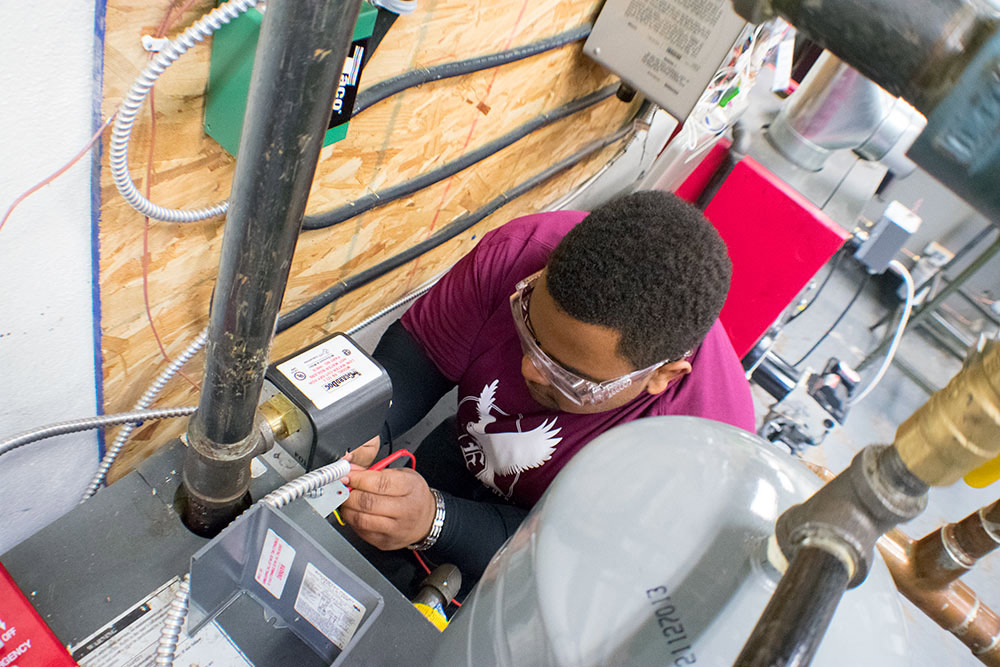
Your first year focuses on safety protocols, tool identification, and fundamental system components. You will assist journeyman technicians with basic maintenance, cleaning, and simple repairs. The goal is to build a solid foundation before touching complex systems.

You begin installing and servicing major components like compressors, coils, and refrigerant lines. Classroom hours increase to cover thermodynamics and electrical schematics. You start performing diagnostics under supervision, learning to read blueprints and system layouts.

This year shifts focus to complex diagnostics and repair. You will handle more advanced electrical issues and refrigerant recovery independently, with less direct oversight. You are expected to solve problems efficiently, applying the theory learned in the classroom to real-world scenarios.

The final year prepares you for the journeyman licensing exam. You will work with minimal supervision, managing projects and mentoring newer helpers. You will review code compliance, energy efficiency standards, and advanced system design to ensure you are ready for full certification.
This progression ensures you are not just a laborer, but a skilled technician. By the end of the program, you will have the experience and knowledge required to pass licensing exams and work independently in the field.
Eligibility and application steps
Many people feel stuck in jobs with no clear path forward, unsure if they have the background to break into skilled trades. The good news is that HVAC apprenticeships are designed for beginners. You do not need prior trade experience to start. The barrier to entry is low, but the commitment is real. If you can meet the basic requirements and follow a structured application process, you can launch a career as a journeyman HVAC technician through a federally accredited program.
Basic eligibility requirements
Before you apply, ensure you meet the standard baseline criteria. Most programs, including those offered by unions and major contractors, require:
- Age: You must be at least 18 years old.
- Education: A high school diploma or GED is mandatory.
- Physical Ability: The work involves lifting heavy equipment, climbing ladders, and working in tight spaces. You must pass a physical fitness assessment.
- Math Skills: Basic algebra and geometry are needed for calculating airflow, electrical loads, and pipe measurements.
- Background Check: A clean criminal background check is typically required for security clearance on job sites.
How to apply
Applying for an HVAC apprenticeship is more structured than a standard job application. You generally have two main pathways: joining a union local or applying directly to a large contracting firm.
- Research Programs: Look for federally accredited programs. These often combine 8,000 hours of paid field training with classroom instruction over four years. Examples include programs like the one offered by Standard AC in Omaha or local union chapters in cities like Portland.
- Prepare Your Documents: Gather your transcript, proof of age, and any relevant certifications (like a driver's license).
- Submit Application: Apply through the union’s website or the contractor’s career portal. Some union programs require you to pass an aptitude test before you can interview.
- Interview: Be prepared to discuss why you want to work in HVAC. Show that you understand the physical demands and the technical nature of the work.
Pre-application checklist
Use this checklist to ensure you are ready to submit a strong application.
-
High school diploma or GED certificate
-
Valid driver's license
-
Proof of physical fitness (medical exam if required)
-
Basic math skills assessment (self-check)
-
Clean background check (no major felonies)
Common mistakes new apprentices make
Starting an HVAC apprenticeship often feels like a fresh start, but the path to becoming a journeyman is paved with avoidable pitfalls. Many new apprentices focus solely on the hands-on work, neglecting the classroom hours required for licensing. This short-sighted approach can delay your journeyman exam eligibility and stall your career growth before it truly begins.
Safety habits are another frequent failure point. Newcomers sometimes mimic the relaxed posture of veteran technicians, ignoring proper protocols for handling refrigerants or working at heights. These aren't just rules; they are safeguards against career-ending injuries or legal liabilities. Treat every job site like a classroom where safety is the primary curriculum.
Networking is equally critical. Some apprentices isolate themselves, viewing journeymen as competitors rather than mentors. Building relationships with experienced technicians provides access to unspoken industry knowledge and future job opportunities.
To avoid these traps, treat your apprenticeship as a holistic education. Balance field work with study, respect safety protocols without exception, and actively engage with your mentors. This disciplined approach ensures you build a solid foundation for a long-term career in the trade.
Frequently asked: what to check next
Career uncertainty often stems from unclear timelines and cost-benefit analysis. The following answers address common concerns about the HVAC apprenticeship path, drawing on official program standards and industry data.
No comments yet. Be the first to share your thoughts!